For Madagascar's Ministry of the Interior and Decentralization: an application to digitize birth certificates kept in paper registers, with a role-based approval workflow.
Project facts
- Period
- January–April 2026
- Context
- Internship
- Team
- solo, supervised by the head of the IT systems maintenance department
- Access
- Confidential code and application
- Role
- End-to-end development: Symfony API, React interface, authentication and roles, tests, user guide and deployment documentation.
- Stack
- Symfony 7API PlatformReactTypeScriptMySQL
Summary
- For
- Civil registration officers of the Ministry of the Interior and Decentralization (MID).
- Problem
- Birth certificates are kept only in paper registers. They need to be entered into a digital system, checked by a civil registrar, then easy to find again.
- Outcome
- Development completed and handed over to the Ministry with a user guide and a deployment procedure; 49 passing automated tests. No information on its use since then.
Overview
Confidentiality
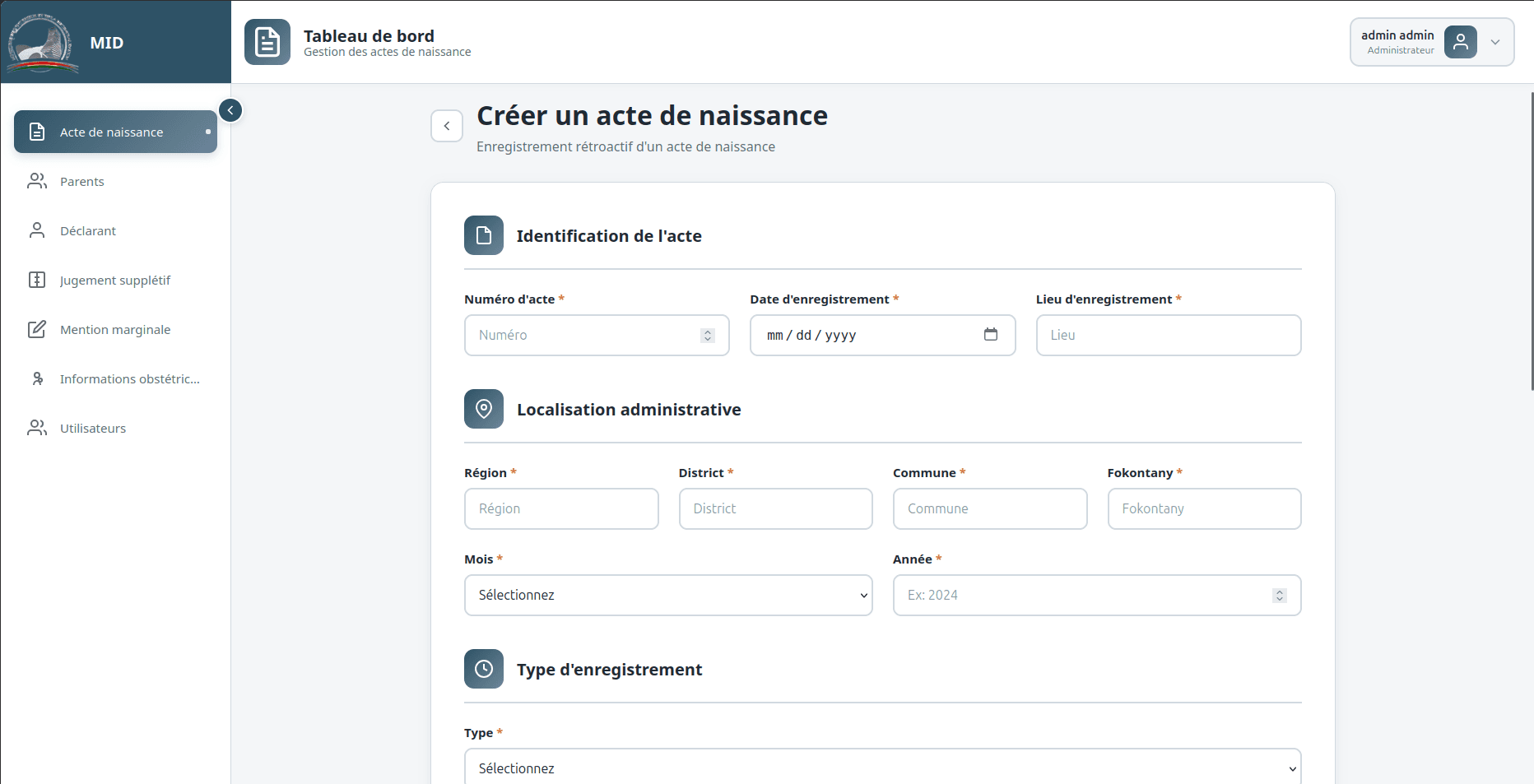
What is not shown: real civil registration data, the source code and the application's address. The screenshots come from an environment without real data; the only visible name (Jean Dupont) belongs to a fictitious account. The interface itself is in French.
Problem
Birth certificates exist on paper in civil registration offices and have to be recorded after the fact in a digital system, with the administrative location (region, district, municipality, fokontany, the smallest administrative unit in Madagascar) and the people linked to the certificate.
Before this project, birth certificates were kept only in paper registers.
My contribution
Internship at the Ministry of the Interior and Decentralization, from January to April 2026 (first commit on January 15, last code commit on April 26). I handled the development on my own, supervised by the head of the IT systems maintenance department.
- Backend: Symfony 7 / API Platform API, data model (certificate, declarant, legal guardians, marginal notes, supplementary court rulings, obstetric information), validation rules.
- Frontend: React interface in TypeScript (data entry, list, filters, decisions).
- JWT authentication and role-based access control.
- Automated backend and frontend tests.
- Documentation: user guide for clerks and registrars, API test plan, deployment procedure.
I did not carry out the production rollout: the deployment procedure is documentation handed over to the Ministry.
Solution
For clerks (data entry)
- Create a birth certificate: identification, administrative location (region, district, municipality, fokontany), registration type, child, birth details.
- Records linked to the certificate: declarant, legal guardians, supplementary court ruling, marginal note, obstetric information.
- Paginated certificate list, with search and filters (sex, status, type).
For civil registrars (review)
- Approve a pending certificate, or reject or cancel it with a mandatory reason.
For administrators
- Account and role management: administrator, registrar, clerk, read-only.
Results
Development is complete and was handed over to the Ministry with a user guide and a deployment procedure. I have no information on the application's use since my internship ended, so no usage data.
Try it
No public demo: this is an internal Ministry application.
Technical details
Key decision
Approval workflow: a certificate entered by a clerk stays “pending” until a civil registrar decides; a rejection or cancellation requires a reason.
Separate data entry from review and keep a written record of every decision, with the author of each creation and change recorded.
Show technical details
Key decision and alternatives considered
- 01
- Choice
- Approval workflow: a certificate entered by a clerk stays “pending” until a civil registrar decides; a rejection or cancellation requires a reason.
- Alternatives considered
- Save the certificate as final as soon as it is entered.
- Reason
- Separate data entry from review and keep a written record of every decision, with the author of each creation and change recorded.
Architecture
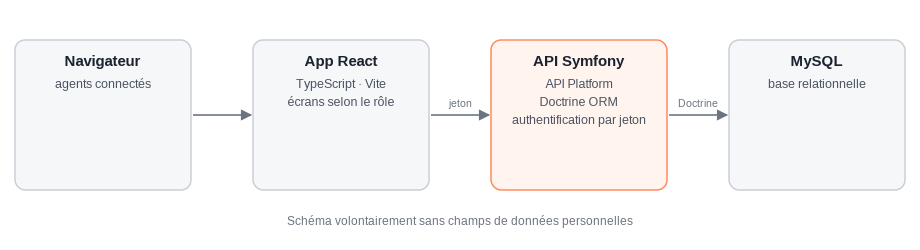
The Symfony backend exposes the business data with API Platform and Doctrine ORM. The React interface, written in TypeScript (Vite), consumes that API.
Security
Measures in place in the code, described without implementation details:
- Sign-in required before any access to data.
- JWT sent in an HttpOnly cookie (unreadable by the page's JavaScript) with SameSite=Lax.
- Role-based access control in the API: only clerks and administrators create a certificate, only registrars approve it.
- An account created through sign-up only gets the read-only role; roles sent by the client are ignored.
- The author of each creation and change is recorded on the records.
Testing and quality
- Backend: 33 PHPUnit unit tests on the Birth Certificate entity (business rules and validation constraints), 98 assertions.
- Frontend: 16 Jest tests (sign-in, certificate list, search hook).
Latest run on November 14, 2026 (PHPUnit 12.5, PHP 8.3; Jest): all tests pass, with 18 PHPUnit notices. An API test plan (Postman) also covers the 401, 403 and 404 cases.
Limitations
- 01Confidential code and application: no public demo.
- 02I did not handle the production rollout: I documented a deployment procedure without carrying it out.
- 03No news about the application's use since the internship ended.
- 04No PDF generation or electronic signature of certificate extracts; only birth certificates are handled (not marriages or deaths).
Proof
No public proof: confidential code and application. The screenshots above are the only material shown.
Contact
Need something similar? Let’s talk.
Describe your project through the form, WhatsApp or email.