To group and share notes as a team: workspaces with pages, roles and comments, built in plain PHP and tested. Public code, app runs locally with Docker.
Project facts
- Period
- March–June 2026
- Context
- Personal project
- Team
- solo
- Access
- Public code, no live demo
- Hosting
- Local (Docker Compose)
- Role
- Framework-free PHP backend, REST API, JavaScript frontend, PHPUnit tests and Docker containerization.
- Stack
- PHP 8.3MySQL 8JavaScriptPHPUnitDocker
Summary
- For
- Small teams or students writing notes and documentation together.
- Problem
- Notes scattered across files and messaging apps are hard to find and to share with the right people. They need to be grouped by workspace, with control over who can read or edit them, and a place to discuss them.
- Outcome
- Personal project: application that runs locally with Docker Compose, 23 passing HTTP integration tests.
Overview
Problem
A team writing notes or documentation needs to group them by topic, give everyone the right level of access (read, edit, admin) and comment in the same place. I built this application without a framework, as a deliberate choice: writing the router, middleware and data access by hand.
My contribution
Built solo from March to June 2026: backend, API, frontend, database schema, tests and containerization.
Solution
For workspace owners
- Create workspaces and pages.
- Invite members with a role: viewer, editor or admin.
- Share a page as read-only or editable, and moderate comments.
For every user
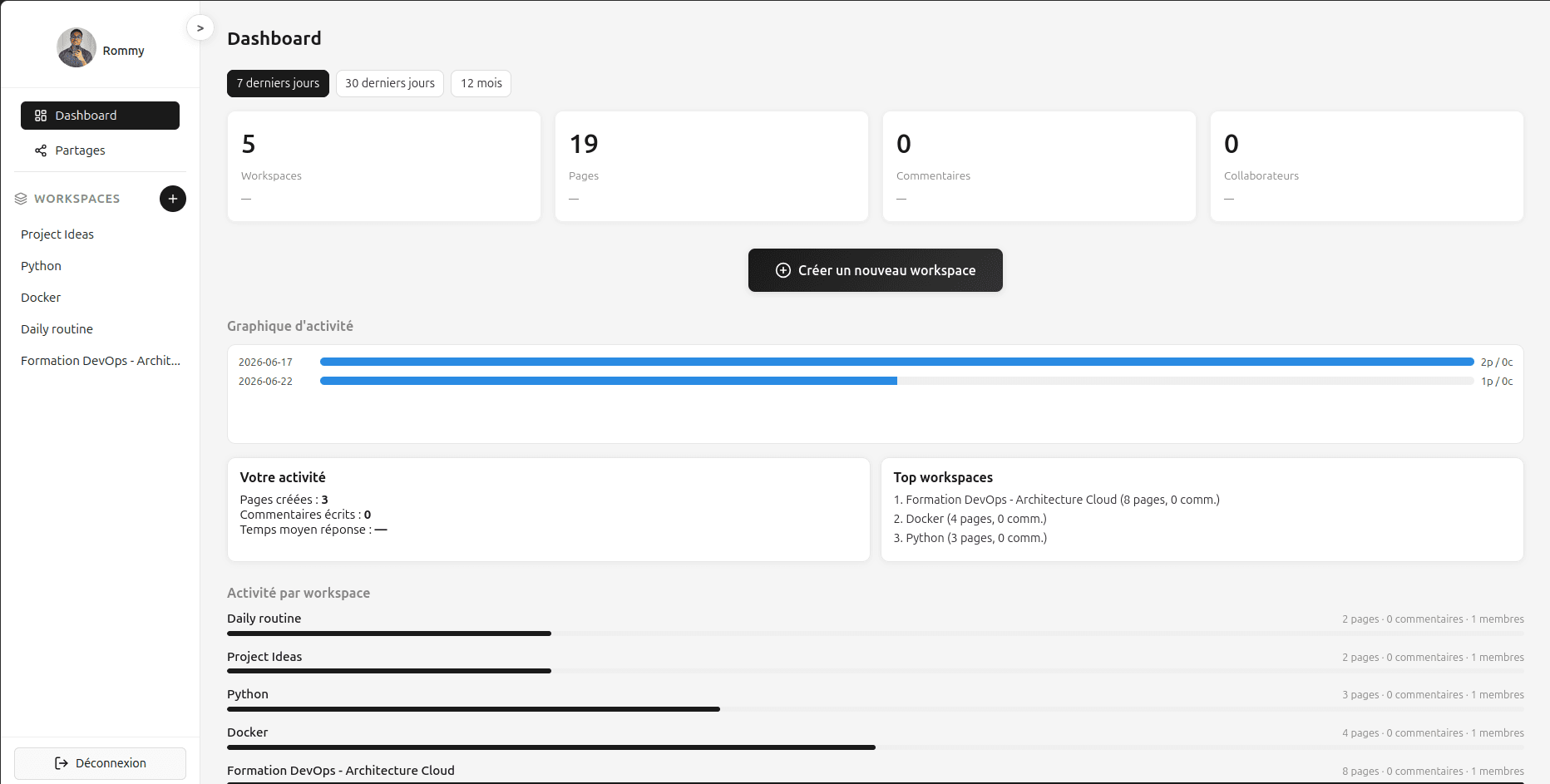
- Dashboard: workspaces, pages, comments, collaborators and recent activity.
- Comments on pages; only the author can edit their own.
- Profile with avatar (JPG, PNG, GIF or WebP, 5 MB max, type checked on the server).
Results
- 23passing HTTP integration tests (4 files)Source · PHPUnit 12.5, run on Nov 14, 2026
- 60assertions checked by these testsSource · PHPUnit 12.5, run on Nov 14, 2026
- 33declared API routesSource
- 6tables linked by foreign keysSource
No real-world usage data.
Try it
No live demo: the code is public and the application runs locally with Docker Compose (docker compose up --build, then http://localhost:8080). The MySQL database is initialized automatically on first start. The steps are detailed in the README (in French).
Technical details
Key decision
Plain PHP, no framework.
Write the router, middleware and request-response cycle myself to understand what a framework automates.
Show technical details
Key decisions and alternatives considered
- 01
- Choice
- Plain PHP, no framework.
- Alternatives considered
- Laravel or Symfony.
- Reason
- Write the router, middleware and request-response cycle myself to understand what a framework automates.
- 02
- Choice
- PHP sessions rather than JWT.
- Alternatives considered
- JWT stored on the client.
- Reason
- The frontend is served from the same domain as the API: a session cookie is enough and can be revoked on the server.
- 03
- Choice
- HTTP integration tests rather than unit tests.
- Alternatives considered
- Unit tests of controllers and models.
- Reason
- Check the whole chain (router, middleware, SQL) on a dedicated database, which is where access-control bugs live.
Architecture
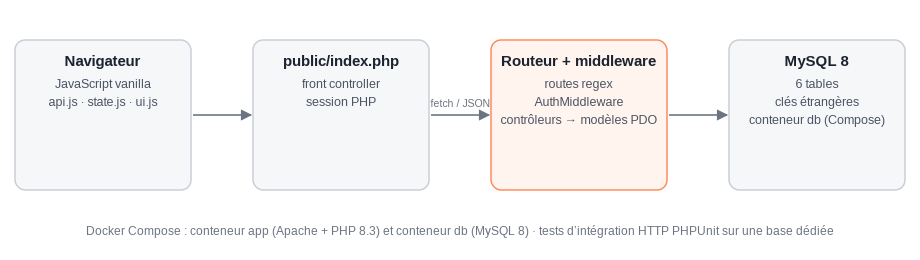
Every request goes through public/index.php. A regular-expression router maps each route to a controller, after the authentication middleware. Controllers validate input and return explicit HTTP status codes; models contain only the SQL queries. In the browser, state.js holds the state, ui.js renders and api.js calls the API.
The schema links users, workspaces, workspace_members, pages, page_shares and comments. Deleting a workspace cascades to its pages, comments, members and shares.
Security
- Passwords hashed with
password_hash(bcrypt). - PDO prepared statements for every database access.
session_regenerate_id()after sign-in.- Identical sign-in error message for an unknown email and a wrong password.
- Access control on every route: authentication, resource existence, user permissions.
Testing and quality
23 PHPUnit integration tests send real HTTP requests to a dedicated database: authentication, workspaces, collaboration and page sharing, including denied cases (access without a session, non-member user, read-only share).
Latest run (PHPUnit 12.5, PHP 8.3, November 14, 2026): 23 tests and 60 assertions, all passing.
Limitations
- 01No CSRF protection: no token check on requests that modify data.
- 02No rate limiting on sign-in attempts.
- 03The session cookie's HttpOnly flag is not enforced in code: it depends on the server's php.ini settings.
- 04public/index.php enables display_errors: PHP errors would be shown to visitors if the app were deployed as is.
- 05Tests do not run in continuous integration: they are run by hand.
Contact
Need something similar? Let’s talk.
Describe your project through the form, WhatsApp or email.